




This seminar series was created to foster collaboration, strengthen the BOR community, raise interest in BOR topics, increase the visibility of BOR, and fast deliver new ideas.
The seminars are scheduled for 40 min. The generic timetable suggests a brief introduction (5 min), a contribution (20 min), and a discussion (15 min). However, there is flexibility concerning the length of the contributions. In addition, there is an opportunity for those interested in staying in the room to continue discussions.
The seminar takes place during “Brownbag-time for Europeans”
12 PM to 12.40 PM (UK, London)
1 PM; to 1.40 PM (CET, Berlin)
It is scheduled bi-monthly every 2nd Thursday of every second month, under consideration of other workshops, conferences, etc. The next dates are the following:
April 9, 2026, June 11, 2026, October 8, 2026, December 10, 2026
Different types of contributions are possible: Conference talks – work in progress, Mini-panel discussions with pre-assigned panelists, Open discussion with initial input of one contributor, Editors of journals discussing publishing BOR papers, Finding collaborators – e.g., Ph.D. students presenting their work and looking for a collaborator they could benefit from.
Please reserve your BORB2S2 presentation date! Only an abstract of the talk is needed. Topics can cover any facets of BOR. Self-promotions are highly welcome. You can also suggest other speakers. Send all enquiries to Johannes Siebert (Johannes.Siebert (at) mci.edu)
-
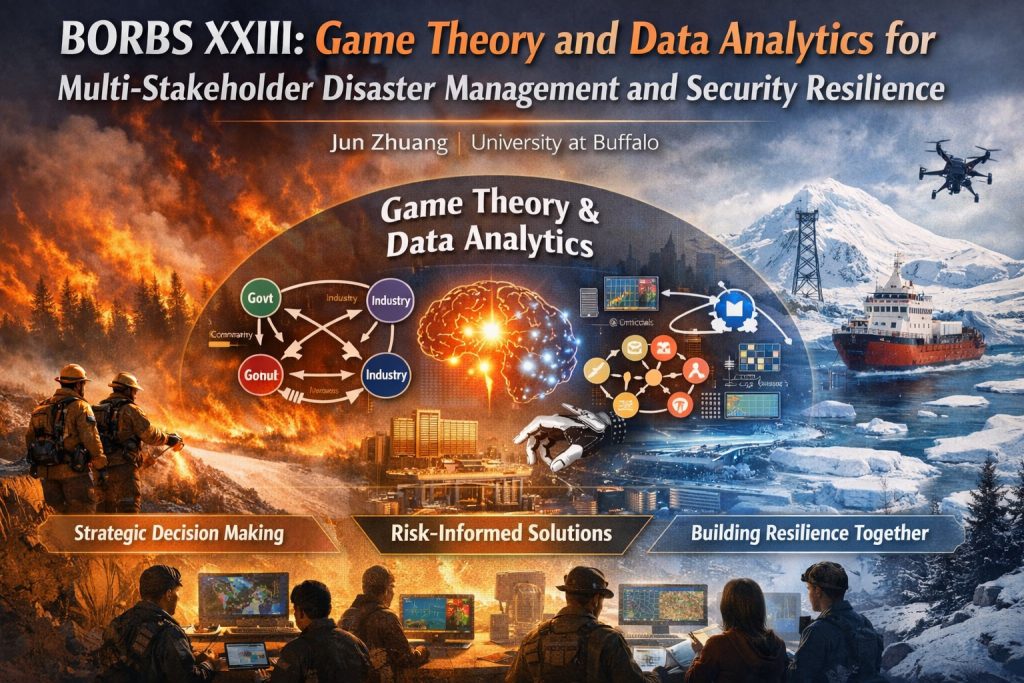
Authors: Jun Zhuang (University at Buffalo)
Abstract
Society faces growing risks from natural and human-caused disasters such as wildfires, extreme weather, infrastructure disruptions, and emerging security threats. Building resilience requires coordinated decision-making among multiple stakeholders—including governments, industry, communities, and strategic adversaries—with differing objectives and incentives. This research develops a unified framework integrating game theory, data analytics, and artificial intelligence, including reinforcement learning, to study strategic interactions and adaptive decision-making in disaster management and homeland security. The work designs risk-informed policies that balance efficiency and equity, public and private investment, preparedness and response, and economic development and safety. Applications span wildfire management, public safety, misinformation, border and infrastructure security, and Arctic resilience, advancing next-generation decision-support tools for adaptive and coordinated disaster resilience.
Why should you join?
Reasons why one should attend: This seminar explores how behavioral operations research can be integrated with game theory, artificial intelligence, and reinforcement learning to better understand multi-stakeholder decision-making in disaster management. Attendees will gain insights into how human behavior, strategic interaction, and AI-assisted decision support jointly shape resilience policies in complex environments such as wildfire management and public safety systems.
Additional comment: Jun will also provide insights about publishing a paper in the interface of BOR and DA in the INFORMS Journal Decision Analysis
April 9th, 2026
12 PM to 12.40 PM (UK, London)
1 PM; to 1.40 PM (CET, Berlin)
https://us02web.zoom.us/j/89143663283?pwd=kxdJrqXHfZ0O2nJVPL7TgfCBfuJtRq.1
Meeting-ID: 891 4366 3283
Kenncode: 1
Comment: In case of technical problems, please visit https://www.euro-online.org/websites/bor/behavioral-operation-research-brown-bag-seminar-series/ before the start of the meeting.
-
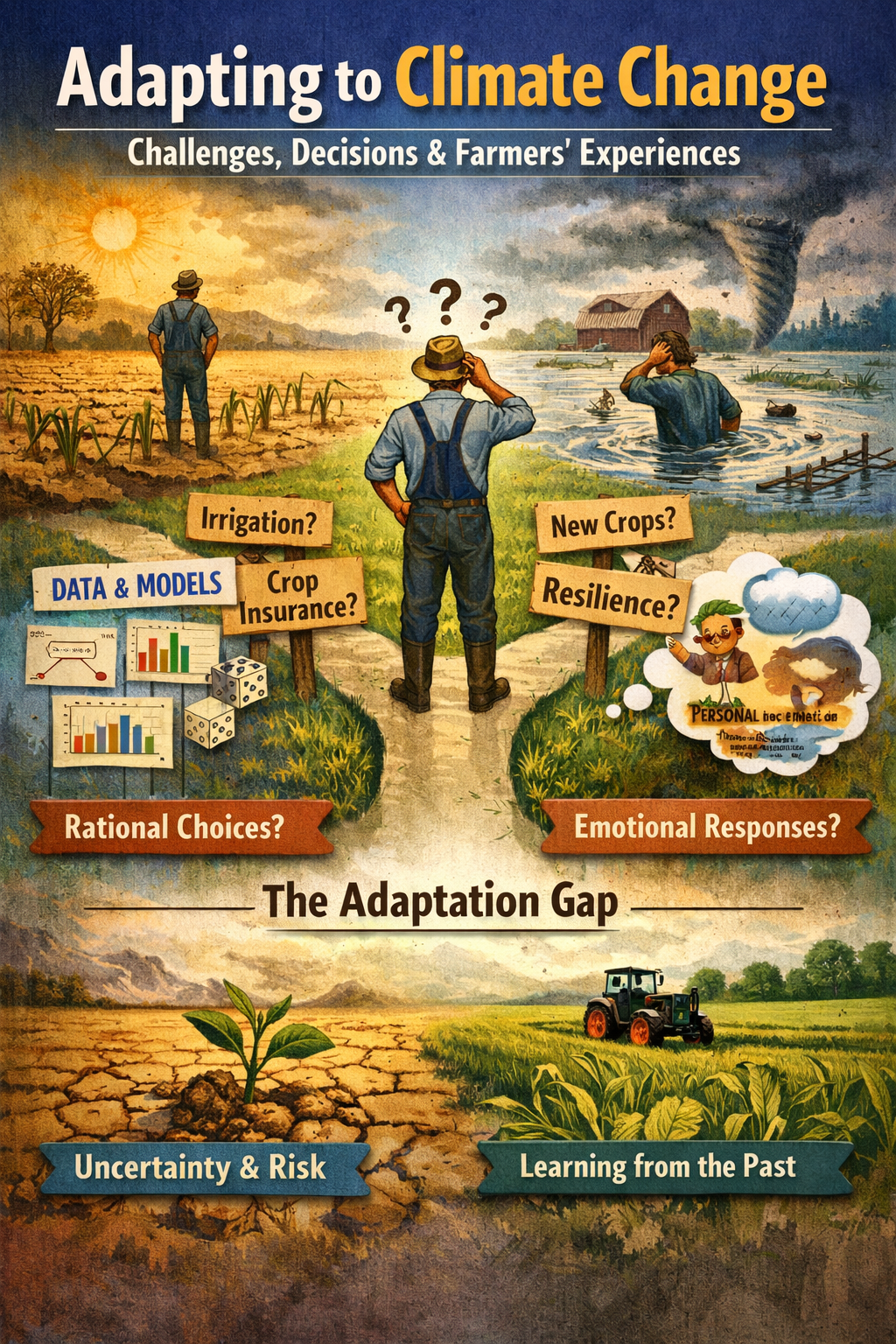
Authors: Oliver Behn (University of Göttingen), Michael Leyer (University of Marburg), Silke Hüttel (University of Göttingen)
Abstract
Climate change unfolds through increasing frequency and magnitude of climate extreme events posing threats to agricultural productivity, farm incomes, and economic resilience of food systems. In response, farms face an urgent need to adapt their production systems. However, empirical research consistently reports significant adaptation gaps.
Many economic and climate-related decision models are based on the assumption that adaptation decisions are made from description. In these models, farmers are expected to evaluate adaptation options by considering their anticipated consequences under future climatic conditions, often relying on assumed probabilities of future agro-climatic states. Such approaches, however, often insufficiently capture the complexity of real-world decision-making under uncertainty.
In practice, farmers are often uncertain about the likelihood, timing, and severity of future climate extreme events. Moreover, human factors such as cognitive biases, emotions, and subjective risk perceptions are frequently overlooked. However, farm adaptation decisions are more realistically understood as a “wicked problem” with no clear or universally optimal solution. In such situations, farmers may rely less on abstract probabilistic information and instead draw on personal experiences with past climate extreme events when making adaptation decisions.
This presentation provides an overview of how farmers adapt to climate change and discusses different types of adaptation strategies. It further presents experimental results that examine the role of personal experience with climate extreme events in shaping farmers’ adaptation behavior.
Why should you join?
– Participants will gain insight into how climate adaptation is implemented in agricultural contexts and the key challenges farmers face.
– The presentation will report experimental evidence on how the cognitive processing of experienced climate extreme events influences farmers’ decision-making.
February 12th, 2026
12 PM to 12.40 PM (UK, London)
1 PM; to 1.40 PM (CET, Berlin)
https://us02web.zoom.us/j/89143663283?pwd=kxdJrqXHfZ0O2nJVPL7TgfCBfuJtRq.1
Meeting-ID: 891 4366 3283
Kenncode: 1
-

BORBS XXI: Behavioural Dynamics in Human–GenAI Interaction: Between Tools and Partners
Wieland Müller (University of Rostock), Oliver Behn (University of Göttingen), Johannes Wichmann (University of Marburg), Alexander Richter (University of Wellington) and Michael Leyer (University of Marburg)
Abstract
Generative AI (GenAI) is increasingly embedded in everyday work and decision processes, where it is perceived not only as a tool but also as an assistant or partner. This research investigates how such perceptions shape interaction behaviour, trust, and responsibility in human–GenAI interaction. In a first study, we explore how people describe their engagement with AI and the roles they attribute to it—from automated tool to creative partner—together with the factors that influence these perceptions and interaction styles. Building on these insights, a second study examines how different types of tasks relate to distinct patterns of human–GenAI interaction and whether recurring combinations of task demands and interaction stages can be identified. Together, the studies provide a comprehensive view of the behavioural and contextual mechanisms that shape how humans and GenAI systems work together and what conditions foster effective, adaptive, and trustworthy collaboration.
Why should you join?
The talk addresses one of the most pressing topics in Behavioral OR and organizational research today: how humans collaborate with generative AI systems. Participants will gain insights into the behavioural mechanisms shaping human–GenAI interaction and learn how perceptions of AI—as tool, assistant, or partner—affect engagement. The presentation will also discuss empirical findings from two complementary studies, offering conceptual and practical implications for designing effective and trustworthy human–AI interactions in decision and work contexts. Moreover, the session invites an open discussion on how BOR perspectives can contribute to understanding and improving human–GenAI decision processes.
December 11th, 2025
12 PM to 12.40 PM (UK, London)
1 PM; to 1.40 PM (CET, Berlin)
https://us02web.zoom.us/j/89143663283?pwd=kxdJrqXHfZ0O2nJVPL7TgfCBfuJtRq.1
Meeting-ID: 891 4366 3283
Kenncode: 1